
Stratusphere UX integration with Business Intelligence, Data Mining and ServiceDesk Workflows

The Stratusphere UX platform has always been about getting
enterprises the data that it needed to make better decisions. This was often
accomplished through dashboards and custom reports available to administrators.
Additionally, the data within Stratusphere UX plays a key role in troubleshooting
exercises across any platform. At its core Stratusphere UX will always provide
great focus around collecting and analyzing desktop, application and
infrastructure metrics for the enterprise to consume.
The idea of “Business Intelligence” is not a new concept by
any stretch. Companies have been collecting data around human behavior for
decades and leveraging that analysis for strategic purposes or to make course
corrections. Department stores for example have studied customer traffic
patterns for decades around how to plan for the layout of the store. Web design
is constantly focused on the page layout and how it applies to spending
patterns and eyelines.
Over the last few years, there has been some movement around
Business Intelligence integration within the enterprise IT space. Several
companies have started to provide focus on Business Intelligence capabilities
for enterprises. Microsoft now promotes a platform called Power BI, Salesforce
acquired a company called Tableau, Google acquired a company called Looker and
ServiceNow has been slowly evolving its automation capabilities to expand into
the space.
One thing that each of these platforms have in common is the
need for external data sources that serve as the baseline for the “Data
Visualization” workflows. Essentially, you point to data sources, interpret the
data and then build or customize the business intelligence workflows to suit
the enterprise needs.
Based on the current trends, Liquidware has started to
explore ways Stratusphere UX can integrate with Business Intelligence workflows
for the enterprise. Stratusphere UX has
had a robust API for many years and now has the opportunity to evolve into a
“Data Mining” engine. As you will see below, we have had some interesting early
success integrating with the various platforms.
Power BI
Power BI
is a business analytics service that delivers insights to enable fast, informed
decisions.
- Transform data into stunning visuals and share
them with colleagues on any device. - Visually explore and analyze data—on-premises
and in the cloud—all in one view. - Collaborate on and share customized dashboards
and interactive reports. - Scale across your organization with built-in
governance and security.
What we have discovered during our exploration is that
partners and large system integrators seem interested in building their own
dashboards or “data visualizations” within Power BI.
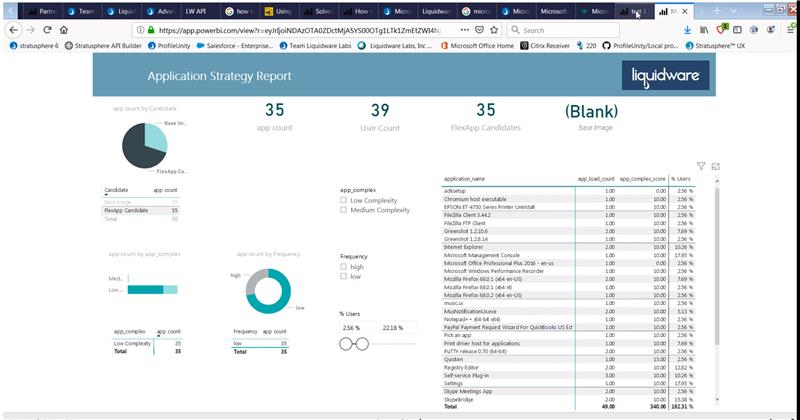
Application Strategy has been a focus within Stratusphere UX
for several years now. Collecting and combining enterprise metrics around
installed vs used, application inventory, application footprint on disk and
overall application performance statistics as part of the evolving Application
Strategy approach.
As you will see in the graphic below, we have combined the metrics
within Stratusphere UX with the Power BI platform for this sample Application
Strategy guidance output.
This is a blog written by Perparim Bislimi, one of our
senior solution architects in EMEA, describing how to integrate Stratusphere
UX data with Power BI
Stratusphere
UX is available as an appliance within the Azure Marketplace. Once
deployed either within the customers on prem environment or within their Azure
instance, Stratusphere metrics can be integrated with the Power BI platform for
data visualization.
Tableau
Tableau is another example of a robust, growing data
visualization, business intelligence platform. SMP-CORP, an award-winning IT
Solution provider based in NY and one of Liquidware’s core partners, has been
integrating with Tableau for a few years now. Leveraging Stratusphere UX data
behind the scenes, in conjunction with Tableau, SMP creates focused data models
and dashboards to share with customers as part of their managed services
offerings. Helpdesk, infrastructure management, enterprise resource availability
are just a few of the workflows SMP manages leveraging Stratusphere UX metrics
in the background.
Here is a link to
the SMP-CORP website discussing some of their managed services
offerings where Liquidware is working behind the scenes.
ServiceNow
ServiceNow
delivers digital workflows that create great experiences and unlock
productivity for employees and the enterprise.
One of the core benefit examples of ServiceNow is around
helpdesk or enterprise alert notification ticketing workflows. ServiceNow can
build automated web-based workflows that enterprise admins can essentially
access from anywhere.
What we have discovered during our exploration is that
partners and large system integrators would see great value by integrating
additional metrics
into core ServiceNow workflows. [RD1]
Liquidware is currently working towards early phase data
mining integration with existing ServiceNow Apps as well as customer workflows.
AWS QuickSight
Amazon
QuickSight is a
fast, cloud-powered business intelligence service that makes it easy to deliver
insights to everyone in your organization.
As a fully
managed service, QuickSight lets you easily create and publish interactive
dashboards that include ML Insights. Dashboards can then be accessed from any
device, and embedded into your applications, portals, and websites.
Stratusphere
UX is available as an appliance within the AWS Marketplace. Once
deployed either within the customers on prem environment or within their EC2
instance, Stratusphere metrics can be integrated with the AWS Quicksight
platform for data visualization.
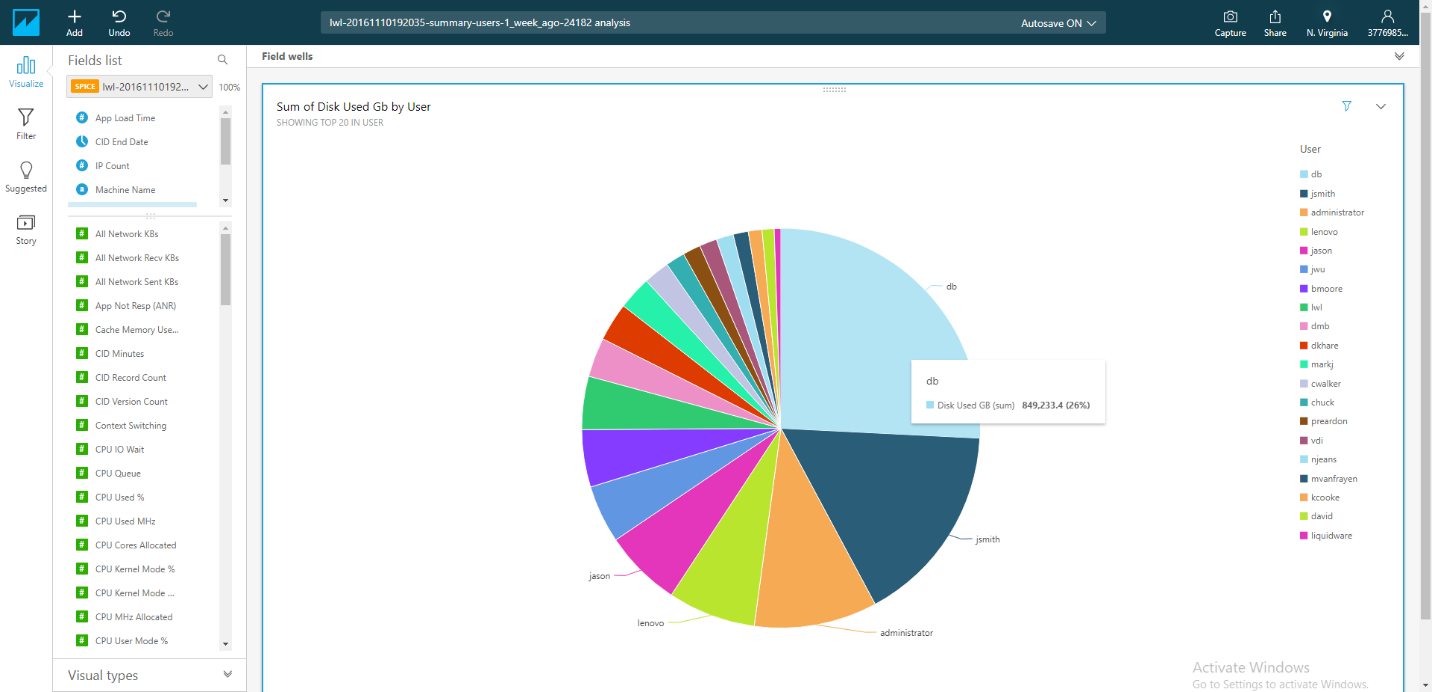
As you can
see from the graphic below, we are displaying overall usage metrics within AWS
QuickSight.
The bottom line is that Liquidware is very excited to evolve
and expand the use cases for Stratusphere UX metrics.
If you have any questions around Stratusphere UX, business
intelligence or data mining capabilities please do not hesitate to reach out to
us at Alliances@liquidware.com
For additional information please visit Liquidware.com